
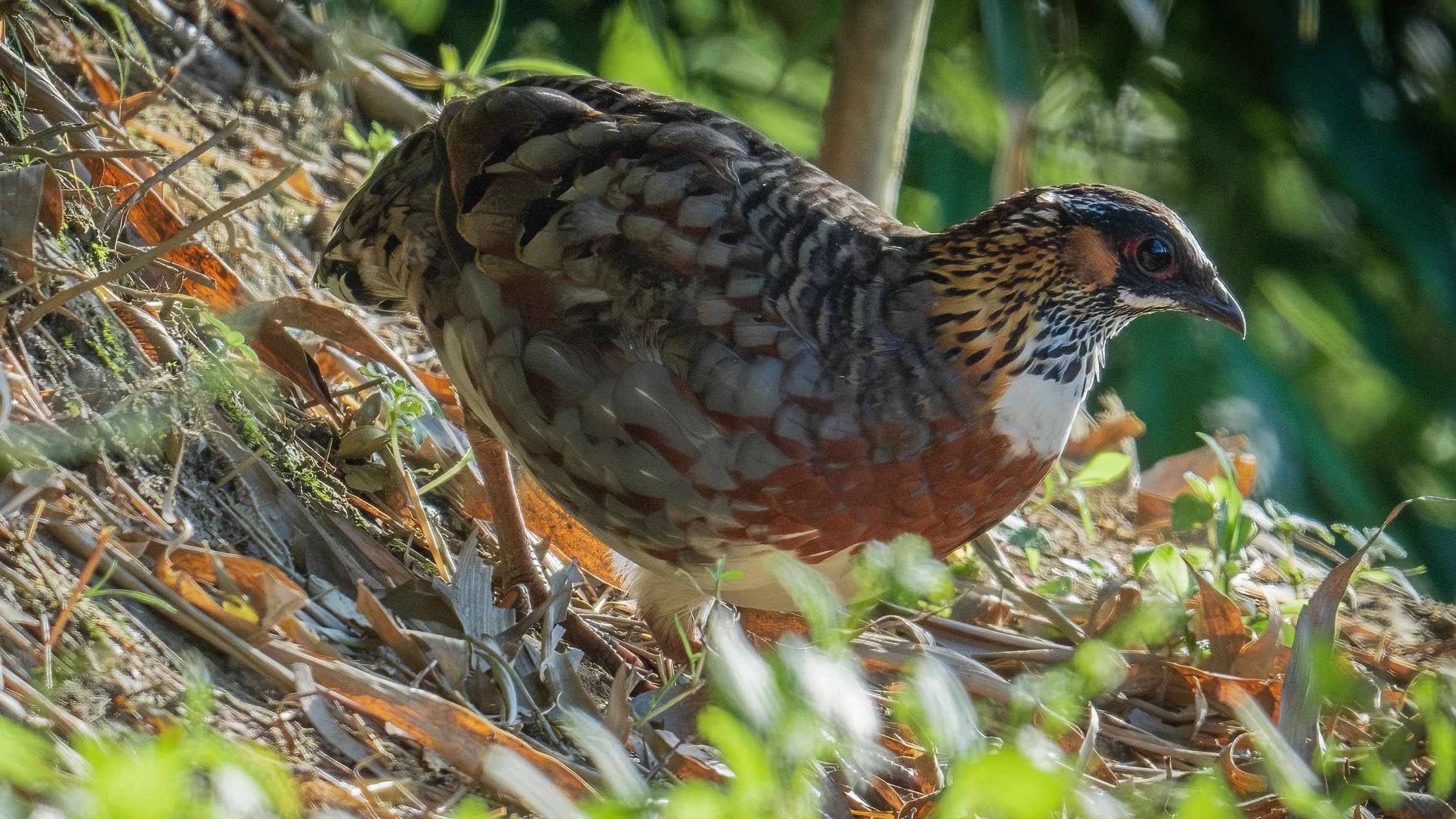
I attempted the famous Sichuan Partridge hide in April 2024 but failed to see it after a two-day effort (check here). Ironically, the partridge appeared just after I left Sichuan. After four months, I decided to try it again.
Note: Some photos were taken from the hides, as declared in their captions. For the scientific names of the birds in the text, please refer to the list at the end of this blog.
The village director, Tian, drove us from the railway station in Jianwei to the village. It was a three-hour drive and dark when we arrived at the Tanshi village (碳石村). According to the owner, Ms. Yan, Sichuan Partridges had visited the No.4 hide with their chicks for two weeks. They came every day until we arrived when it was heavily rainy earlier that day, and nobody visited that hide. But that morning, the eleven visitors at another hide still had the chance to see a pair of the partridges several times. Everything sounded promising!

August 11th: A Frustrating Beginning
We started at 7:00 in the No.4 hide. I remembered this fairly clearly since it was the last place I visited. At that time, only Bamboo-Partridges visited this hide. I did not know that the story became identical that day. There was nothing in the hide but five bamboo partridges, two adults, and three juveniles. A Golden Parrotbill passed the hide, and two Leiothrixes regularly visited the feeder. That was it! I never expected that, but we became the witness of the end of the Partridge season of No.4 Hide. According to the owner, it seemed that the parental bird would now help the grown-up chicks disperse to the mountains; once they had left, they would not return for two months.


After half an hour, we finally heard the call from Sichuan Partridge remotely from another mountain, almost in another world to me. Besides that, we only listened to a few of the most common bird calls there: Pgymy Cupwing, Rufous-capped Babbler, Streak-breasted Scimitar-Babbler, etc. After 8:00, the owner, Zeng, suggested we move to another hide, where another couple of Sichuan Partridges visited yesterday.


We spent the rest of the day in that hide. I sat in that hide for the next two days as well. In the end, we heard Sichuan Partridge remotely around 13:30, 16:05, and 16:11. They never came. The most common visitors to the hide were two species of squirrels. The owner even prepared the cage to control the squirrel, though temporarily not in use. For other birds, all the regular visitors were there:


Temminck’s Tragopan: A male came to the corn feeder. 9:25–9:35.


Lady Amherst’s Pheasant: There were two males. I was not sure whether they were the same individual. The first visit to the hide was at 10:00, and the second was at 10:11.

Silver Pheasant: One male visited twice at 11:55 and ten minutes later.
Chinese Bamboo-Partridge: Five birds visited at 14:00. One looked slightly larger than the other. Another three birds were heard.
Others: Red-billed Leiothrix and Chinese Babax were numerous and repeatedly visited the feeders; a gray Wagtail walked on the roof of the hide, suddenly flew to the main course of the hide region, and stayed for a second; Brown-breasted Bulbuls and Mountains Bulbul sometimes visited the bamboos or trees in the surrounding; we heard Great Barbet, Oriental Turtle-Dove, Gray-headed Canary–Flycatcher, Brownish-flanked Bush Warbler, Gray-headed Bulfinch and Ashy–throated Parrotbill in the background., etc.

Meanwhile, I noticed a tiny “mouse” sometimes appearing in the afternoon. When I told my friend, she moved the camera, and the “mouse” was somehow disturbed and suddenly fled. I did not get any photos.
My friend Jing needed to leave around 17:00, so we had left the hide by then. After dinner, I sat in the hotel and wondered why the Sichuan Partridge disappeared as soon as we arrived.
August 12th: Still Waiting

I became alone on the second day. The hide owner, Zeng, dropped me at the second hide on the 11th of August. It was around 6:30. Zeng went to hide No.4 to check whether the other partridge with the chick would come—if they did, they would go again in the afternoon.
Sitting in the hide was as dull as yesterday. I made a list of the birds according to the time here until 19:00.

Temminck’s Tragopan: One male feeding in the hide. 13:10. One male 17:59.


Lady Amherst’s Pheasant: One male visited the hide at 12:29, one male at 14:13, one male at 17:07, one male and six female/immature at 18:21. I could see the squirrel lost to the male in a fight, and the male drove away the juveniles on the feeder.

Silver Pheasant: One male was in the hide at 9:55; the same one visited again at 18:39.

Chinese Bamboo-Partridge: 9:09, two individuals; 17:04, two individuals; 18:15, two individuals. Presumably, the same couple.

Oriental Turtle-Dove: 9:26, one individual visited the feeder; 11:34, one individual visited the feeder, heard later, presumed to be the same one; 15:17, two perches on bamboo and then visited the feeder; 16:50, one individual visited.
Great Barbet: I heard one in the background and spotted another right to the hide at 12:55.
Brown-breasted Bulbul: At 10:54, one bird perched on a tree next to the hide, and another flew over at 12:08.
Gray-headed Parrotbill: A small flock feeding on the woods in the background, ~7:15.
Golden Parrotbill: One bird passed the hide region at 8:20.
Vinaceous Rosefinch: Around 9:05, a male visited the dead tree to the right of the hide. It appeared multiple times and sang when perched.
Red-billed Leiothrix and Chinese Babax were as common as the first day.
I heard only the following birds: Bay Woodpecker, Gray-headed Canary Flycatcher, Pygmy Bubl, Brownish-flanked Bush Warbler, and Breasted Scimitar Babbler. I only heard Sichuan Partridge once. It was two birds calling at 7:30.
I had seen all those birds countless times in the field during the past ten years, except for Sichuan Partridge. I was so disappointed that I made a post in my WeChat Moment cursing the partridge: last time, you came just after I left, and this time, you disappeared as soon as I arrived. How dare you to treat such a passionate birder?

Despite the boring experience in the hide, there was still good news: I managed to see and take photos of the “mouse” from the first day. It turned out not to be a mouse but a Shrew Gymnure, a common little animal relative to the hedgehogs.
It started to get dark around 18:00. I had been sitting there for 12 hours, and there was still no Sichuan Partridge! A pair of Bamboo-Partridge, probably the same one, came again, and two Hair-crested Drongos were harshly chatting in the bamboo around. The sunset on that day was about 19:30, and I persuaded Zeng to allow me to stay until 7:15 p.m. After 19:00., no birds visited the hide, except a Mountain Bubul perched on a tree at 19:09.
August 13th: The Last Hope
As I mentioned, on my last visit to Tanshi in April, I stayed for two days, and the Sichuan Partridge visited the hide on the third day. Then I decided that, no matter the cost, I would remain until the third day, as long as I had not seen the partridge.
I got up at 5:00, the same as the past two days—exhausting. Another old guy, Yang, also joined me in the hide. At least I was not lonely now, but I still lacked confidence in the Sichuan Partridge. Would you maintain the expectation if you had failed four days for a bird in the same hide? See it or not, I would leave Tanshi at noon anyway.

Arriving at the hide at 5:30, I heard the Bamboo Partridge around after a while. The expected visitors to the hide were still squirrels, Chinese Babax, and Leithorix. The Shrew Gymnure came again as well. Everything seemed to be the same as the past two days. I sighed and started browsing social media on my phone.

7:52, August 13th, 2024, was the most unforgettable time of my life. While I was still focusing on my phone screen, Yang noticed me: ” The partridge is coming!”
I looked in the hide. A quail-like bird was wondering. Through binoculars, I could see its white neck under the sun. This was a male Sichuan Partridge. Surprisingly, I did not get highly excited. Instead, I feel a huge relief—after all, I planned to leave that afternoon, no matter whether I managed to see it. On the fifth day in Tanshi, I finally got this bird! I felt a bit stressed, as I had to treasure this precious opportunity. I took some photos as soon as possible.

The male was vigilant. It picked up a few corns in the hide, stayed for a few seconds, and suddenly ran away. I remember Per telling me that when he first met Ben King in Chengdu in 1987, Ben first said: ” I got rufipectus yesterday!” He had a massive smile on his face. I understood his feelings at that moment.

The female partridge was more tame and fed on the corns for roughly five minutes. I took a few photos and recorded a short video. I still felt unreal and did not believe this dream bird had come. Ever since the discovery, people have found observing this mysterious bird challenging. In the early 2000s, the only way to see it correctly was to follow a hunter’s way to find the resting branches. Sichuan Partridge forages in the bamboo woods during the day and sleeps at some tree branches. Instead of flying to the branch, the partridge walks. Finding one in sleep was how people hunted them in the past and how to see them later in history. We are already lucky that now we have the hide to wait for it.

I stayed in the hide until noon. Meanwhile, Temminck’s Tragopan, Lay Amherst’s Pheasants, and Silver Pheasants came one after another, just like the past two days. Yang was very interested in those birds, and he was a dedicated photographer, so he spent time taking photos. On the other hand, I was already. The light improved later in the morning, but the Sichuan Partridge no longer appeared.

On the way back, Tian drove me to the nearby airport at Yibin. He told me I was not the unlucky one for the Sichuan Partridge. People used to spend one week or even ten days waiting for it. Another birder from Singapore spent only two days and failed like I did, but he had to return to work after that. The partridge appeared on the third day. Despite many people also seeing it on their first day, the stable seasons for Sichuan Partridge were only about two months: one month in early spring and one month in which they bring the chicks to the hide in the breeding season. Otherwise, they are unpredictable and may appear once every two or three days. You will have to ask the hide owner before departure.
When I returned from Tanshi, I saw Lei Zhu’s article in memory of Ben King, who passed away in May 2024. Ben managed to find Sichuan Partridge in Sichuan in the 1980s when there was no convenient transportation or information about the mysterious Sichuan Partridge, and of course, no hide like this. What they did must have been looking for the bird. I can’t imagine how hard it was, but he must have dedicated his life to it. He was a great pioneer in Asian Onirhitology, and his legend will encourage further exploration like a lighthouse. Rest in peace, Ben King.
eBird Trip Report: https://ebird.org/tripreport/267187
Bird list:
Arborophila rufipectus Sichuan Partridge 8
Tragopan temminckii Temminck’s Tragopan 5
Chrysolophus amherstiae Lady Amherst’s Pheasant 19
Lophura nycthemera Silver Pheasant 3
Bambusicola thoracicus Chinese Bamboo-Partridge 13
Streptopelia orientalis Oriental Turtle-Dove 8
Spilopelia chinensis Spotted Dove 1
Egretta garzetta Little Egret 1
Psilopogon virens Great Barbet 4
Blythipicus pyrrhotis Bay Woodpecker 3
Dicrurus hottentottus Hair-crested Drongo 2
Corvus macrorhynchos [macrorhynchos Group] Large-billed Crow (Large-billed) 1
Culicicapa ceylonensis Gray-headed Canary-Flycatcher 3
Pnoepyga pusilla Pygmy Cupwing 3
Ixos mcclellandii Mountain Bulbul 3
Spizixos semitorques Collared Finchbill 1
Pycnonotus xanthorrhous Brown-breasted Bulbul 4
Pycnonotus sinensis Light-vented Bulbul 1
Horornis fortipes Brownish-flanked Bush Warbler 16
Psittiparus gularis Gray-headed Parrotbill 10
Suthora verreauxi Golden Parrotbill 16
Suthora alphonsiana Ashy-throated Parrotbill 2
Cyanoderma ruficeps Rufous-capped Babbler 1
Pomatorhinus ruficollis Streak-breasted Scimitar-Babbler 3
Trochalopteron formosum Red-winged Laughingthrush 1
Leiothrix lutea Red-billed Leiothrix 18
Pterorhinus sannio White-browed Laughingthrush 1
Pterorhinus lanceolatus Chinese Babax 34
Leiothrichidae sp. (laughingthrush sp.) laughingthrush sp. 1
Phoenicurus auroreus Daurian Redstart 1
Passer montanus Eurasian Tree Sparrow 1
Motacilla cinerea Gray Wagtail 1
Motacilla alba White Wagtail 1
Carpodacus vinaceus Vinaceous Rosefinch 2
Pyrrhula erythaca Gray-headed Bullfinch 1
Pyrrhula nipalensis/erythaca Brown/Gray-headed Bullfinch 2
Leave a Reply