
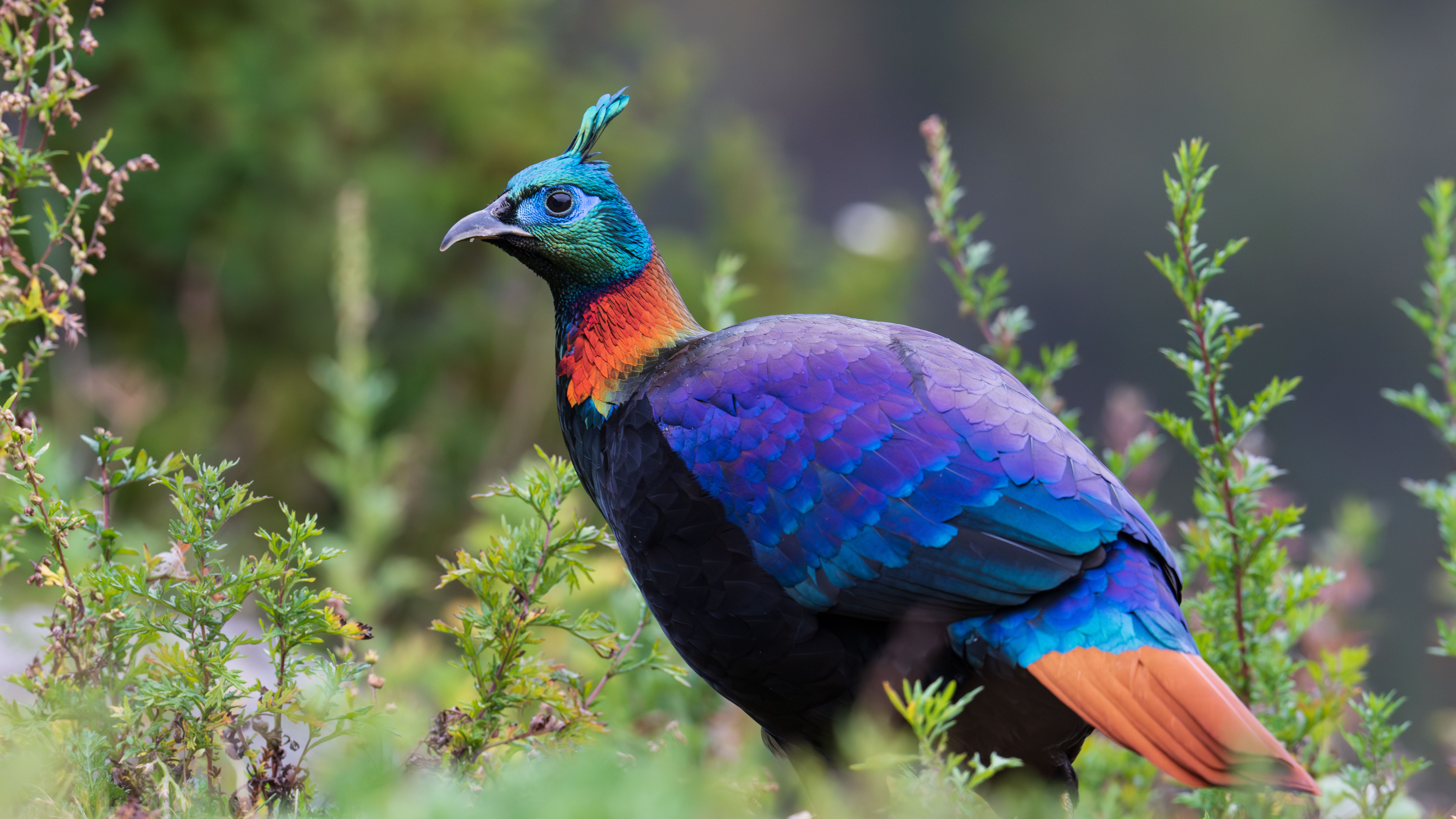
As is widely known, China harbors the highest diversity of Galliformes, with about 64 species in this country. By the end of September this year, I traveled for two unique species in Galliformes, Himalayan Monal and Tibetan Eared-Pheasant. I went there with my friend Shaungqi and a driver, Mr. Shi, to the western border in Xizang. After this trip, we visited Gyirong (Check the report here).
I arrived Lhasa, the capital of Xizang Autonomous Region at the evening. Xizang is called “Tibet” in the old days, while today that name is rarely used in the country. Shuangqi arrived earlier in the afternoon, so he can caught his lifer, Tibetan Blackbirds in a city park.

The elevation of Lhasa is about 3,650 m above sea level. Despite having been in the Tibetan Plateau many times, I still feel a bit of a headache, probably because I traveled directly from the lowlands here. Taking off a tight underwear helped me release a bit. Still, the headache accompanied me for three days until we arrived in Gyirong.
Nevertheless, we departed early on the first day. Mr. Shi picked us up at the hotel and drove to Xiongse Temple (雄色寺) for the first target, the Tibetan Eared-Pheasant.
Xiongse Temple
It took about an hour to drive from downtown Lhasa to Xiongse Temple. On the way, Eurasian Hoopoes, Black-rumped Magpies and Hill Pigeons were common in the agricultral fields.

We soon encountered a few Tibetan Eared-Pheasants when driving uphill along the road. Mr. Shi reminded us there would be more, and we stopped taking photos when we met another large flock of them.


As a tradition, Chinese temples tend to feed wild Galliformes, which usually make the birds very tame to humans, especially in Xizang, where Tibetan Buddhism requires local people not to hunt wildlife. We could approach those pheasants easily, and they even tried to get food from us. Personally speaking, I do not support feeding wildlife usually, as this can modify their behavior and may be harmful to their life. However, it is hard to evaluate that in ethics. We met another car of birders, and they joined us for the photography.

Heading up to reach the temple, we went birding around a bit. If you want Tibetan Snowcock, you would need to arrive there around sunrise, and we could not make it since we arrived too late on the previous evening. The birds there were pretty active.

The highlights included several Giant Babaxes, which are the region’s specialty, and two White-browed Tit-Warblers, a species we had been longing for. Common birds included Prince Henry’s Laughingthrush, Redstarts, Choughs, Accentors, and two Rosefinch species, the Streaked Rosefinch and Crimson-browed Finch. We left Xiongse Temple before noon.
Yamzho Yumco
Driving from Xiongse Temple to the next destination, Kajiu Monastery (卡久寺) takes roughly seven to eight hours. In ancient times, only people who went on a pilgrimage took that route, though nowadays it is popular with tourists.

Except for lunch, we did not make many stops on that way. The longest pulled-over we made was at Yamzho Yumco (羊卓雍错) for a rest, one of the three sacred lakes in Xizang. The scenery was breathtaking.

Yamzho Yumco is not a classic birding hotspot, and there were few birds to see. However, when we went to the toilet, we were shocked to find a Giant Shrike perching on the ground! We tried to find it in the morning, but all the shrikes were Gray-backed. This bird made our day. Shuangqi got this as his lifer.


There is a hotel in the Kajiu Monastery, but it was full of reservations as it was the National Day’s Holiday. We had to stay at a home inn on Lakang town, a place of 20 minutes driving to the monastery. The local govements helped the them build up the inns for tourism, and the locals benefited from that with a higher income. The inn was nice and economical.
Kajiu Monastery: the Dusk
Note: Currently Kajiu Monastery is not open to foriegner vistors, unfortunately, due to the border conflict to India is still not well resolved.

We took a quick look at Kajiu Monastery at dusk. The Himalayan Monals were easy to spot here, as the monks feed them regularly. A few lawns surrounding the Monastery were where they put grains, attracting the monals and many other birds.


Monals were indeed the beauty of the Himalayas. The male bird is usually called “Nine colored bird” by locals and is considered sacred. The female also looks better than the female of the other two monal species. Goral, a species of antelope, also commonly visits the monastery for food. They are very used to humans here.

Other birds included the Himalayan Beautiful Rosefinch, a species I would be tired of later in Gyirong; the Southern Nutcracker, together with the Large-billed Crow, often came to the lawn or perched on the spruces around; and the Oriental Turtle Dove, which was so common and abundant here.

Suddenly, all the birds, including the monals, escaped rapidly. I looked above, and a raptor appeared. However, it turned out to be a harmless first-year Oriental Honey-Buzzard. Its mimicry of, probably, Black Eagle seemed to be effective.


Kajiu Monastery: the Morning


The following day, we got up early and arrived at Kajiu Monastery around sunrise time. What we saw on the lawn was the same as the previous day, including doves, nutcrackers, rosefinches and monals. The feeding started later. A flock of 30 Snow Pigeons from the nearby roof also joined the party. Compared to the Oriental Turtle Dove, the Snow Pigeon was nearly twice as large. If you meet the management people, they will charge you 50 RMB to support the feeding.


Another inner lawn without a fence is a good place for monal photography. The monals, mainly male, were walking there without any regard for humans. Tourists could use their mobile phones to get great shots. Still, it is necessary to keep a distance from those birds.


The trail between the two lawns is suitable for observing the birds in the conifers and the cliff. An important target we had there was the Red-headed Bullfinch. We were lucky to find a couple of them by their calls. Other small passerines were also active around the monastery, like the Black-faced Laughingthrush, which always makes a beautiful song.


White-winged Redstart, which was actually a Luscinia nightingale like the bluethroat, was also common in the surrounding understories. Differing from the other members in Luscinia genus, this species has sexual dimorphism, and the male has remarkable whitish spots on its alulas.

We headed back at about 10:00. On the side of the temple, we encountered a small mixed-feeding flock of small passerines in the forest. Among them, White-browed Fulvetta is the dominant species, together with several Rufous-vented Tits. Another bird with a similar silhouette to the Rufous-vented Tit attracted my attention. It was a Gray-crested Tit, a species I looked for five years in the Sino-Himalayan region. I was extremely excited about it.


Driving in Shannan
We said farewell to Kajiu Monastery and headed to Xigaze to aggregate with another two friends for the continuing trip. The driving took the rest of the day.
On the following way, we saw many flocks of Goas, which had become common on the roadside. This brought back memories of my fieldwork in Qinghai.

The plateau looked dry and silent, but still, there were many passerines. Rufous-necked Snowfinch, Ground Tit, and Redstarts were among the most common birds from the roadside. We also met several Blyth’s Pipits, and it seemed they migrate directly across the Tibetan Plateau—crazy birds! Flocks of Black-winged Snowfinches were also frequently seen, probably in the autumn wandering.

The scenery was also splendid. We were deeply shocked by the endless mountains, glaciers, ancient castles, and wildlife there. As we approached Xigaze, we encountered increasing numbers of tourist groups, some of whom were foreign visitors.


We arrived in Xigaze on that evening. What happened next? Please check the Gyirong report here.
Species Name Sheet
| Scientific | Simplified Chinese | English |
| Tadorna ferruginea | 赤麻鸭 | Ruddy Shelduck |
| Mergus merganser | 普通秋沙鸭 | Common Merganser |
| Lophophorus impejanus | 棕尾虹雉 | Himalayan Monal |
| Crossoptilon harmani | 藏马鸡 | Tibetan Eared-Pheasant |
| Columba rupestris | 岩鸽 | Hill Pigeon |
| Columba leuconota | 雪鸽 | Snow Pigeon |
| Streptopelia orientalis | 山斑鸠 | Oriental Turtle-Dove |
| Grus nigricollis | 黑颈鹤 | Black-necked Crane |
| Chroicocephalus brunnicephalus | 棕头鸥 | Brown-headed Gull |
| Ichthyaetus ichthyaetus | 渔鸥 | Pallas’s Gull |
| Sterna hirundo | 普通燕鸥 | Common Tern |
| Podiceps cristatus | 凤头䴙䴘 | Great Crested Grebe |
| Pernis ptilorhynchus | 凤头蜂鹰 | Oriental Honey-buzzard |
| Buteo hemilasius | 大𫛭 | Upland Buzzard |
| Buteo refectus | 喜山𫛭 | Himalayan Buzzard |
| Upupa epops | 戴胜 | Eurasian Hoopoe |
| Lanius tephronotus | 灰背伯劳 | Gray-backed Shrike |
| Lanius giganteus | 青藏楔尾伯劳 | Giant Shrike |
| Pica bottanensis | 青藏喜鹊 | Black-rumped Magpie |
| Nucifraga hemispila | (南)星鸦 | Southern Nutcracker |
| Pyrrhocorax pyrrhocorax | 红嘴山鸦 | Red-billed Chough |
| Pyrrhocorax graculus | 黄嘴山鸦 | Yellow-billed Chough |
| Corvus macrorhynchos | 大嘴乌鸦 | Large-billed Crow |
| Periparus rubidiventris | 黑冠山雀 | Rufous-vented Tit |
| Lophophanes dichrous | 褐冠山雀 | Gray-crested Tit |
| Pseudopodoces humilis | 地山雀 | Ground Tit |
| Parus cinereus | 大山雀 | Asian Tit |
| Delichon dasypus | 烟腹毛脚燕 | Asian House-Martin |
| Phylloscopus pulcher | 橙斑翅柳莺 | Buff-barred Warbler |
| Phylloscopus affinis | 黄腹柳莺 | Tickell’s Leaf Warbler |
| Phylloscopus trochiloides | 暗绿柳莺 | Greenish Warbler |
| Leptopoecile sophiae | 花彩雀莺 | White-browed Tit-Warbler |
| Fulvetta vinipectus | 白眉雀鹛 | White-browed Fulvetta |
| Trochalopteron affine | 黑顶噪鹛 | Black-faced Laughingthrush |
| Trochalopteron henrici | 灰腹噪鹛 | Prince Henry’s Laughingthrush |
| Pterorhinus waddelli | 大草鹛 | Giant Babax |
| Luscinia phaenicuroides | 白腹短翅鸲 | White-bellied Redstart |
| Phoenicurus frontalis | 蓝额红尾鸲 | Blue-fronted Redstart |
| Phoenicurus hodgsoni | 黑喉红尾鸲 | Hodgson’s Redstart |
| Phoenicurus erythrogastrus | 红腹红尾鸲 | White-winged Redstart |
| Phoenicurus ochruros | 赭红尾鸲 | Black Redstart |
| Saxicola maurus przewalskii | 黑喉石䳭(青藏) | Siberian Stonechat (Przevalski’s) |
| Prunella rubeculoides | 鸲岩鹨 | Robin Accentor |
| Prunella strophiata | 棕胸岩鹨 | Rufous-breasted Accentor |
| Prunella fulvescens | 褐岩鹨 | Brown Accentor |
| Passer montanus | 麻雀 | Eurasian Tree Sparrow |
| Montifringilla adamsi | 褐翅雪雀 | Black-winged Snowfinch |
| Onychostruthus taczanowskii | 白腰雪雀 | White-rumped Snowfinch |
| Pyrgilauda ruficollis | 棕颈雪雀 | Rufous-necked Snowfinch |
| Motacilla alba | 白鹡鸰 | White Wagtail |
| Anthus godlewskii | 布氏鹨 | Blyth’s Pipit |
| Mycerobas carnipes | 白斑翅拟蜡嘴雀 | White-winged Grosbeak |
| Carpodacus pulcherrimus | 红眉朱雀 | Himalayan Beautiful Rosefinch |
| Carpodacus rubicilloides | 拟大朱雀 | Streaked Rosefinch |
| Carpodacus subhimachalus | 红眉松雀 | Crimson-browed Finch |
| Pyrrhula erythrocephala | 红头灰雀 | Red-headed Bullfinch |
| Emberiza godlewskii | 灰眉岩鹀 | Godlewski’s Bunting |
Leave a Reply