
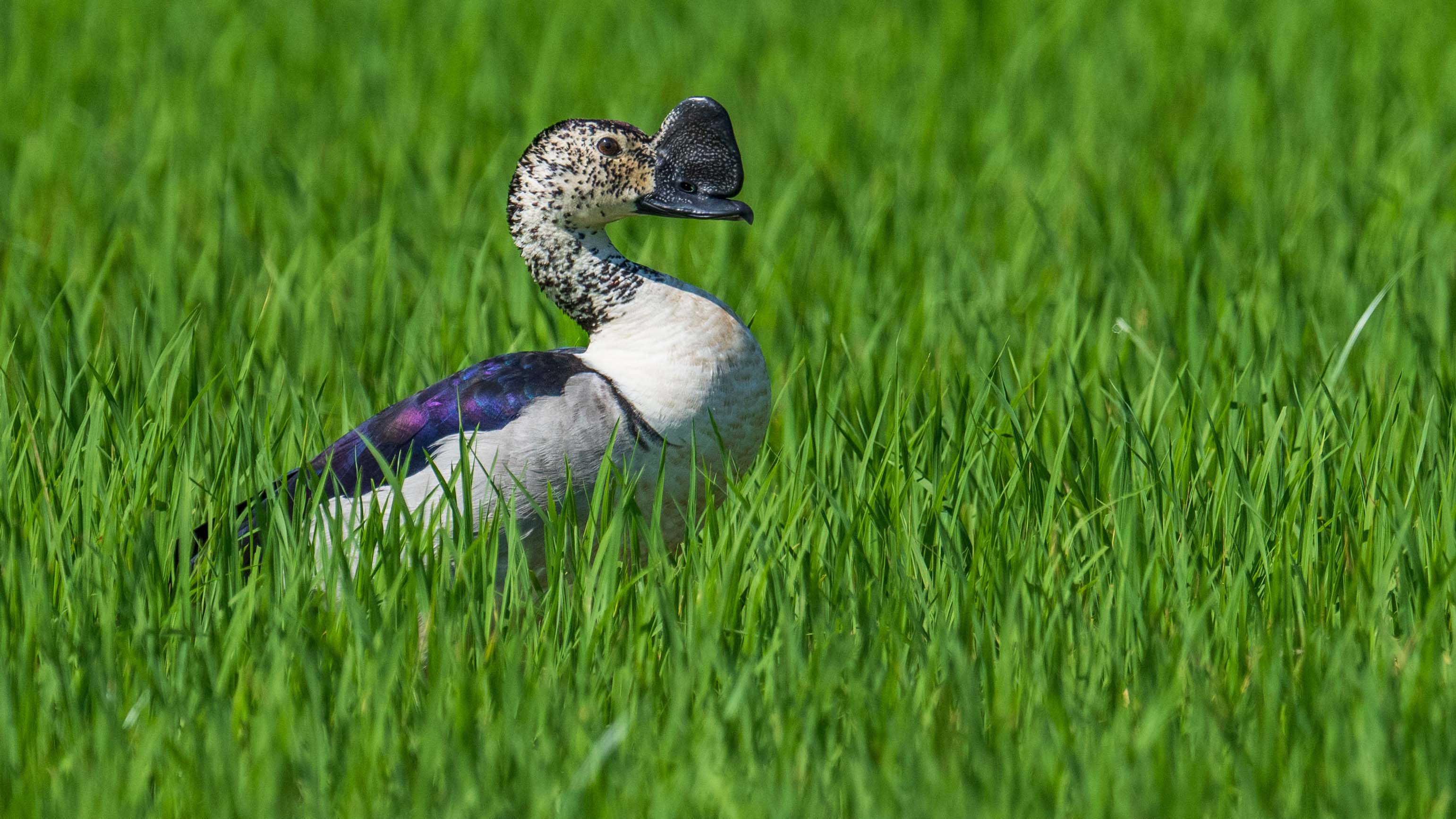
By the end of June, we headed to Songkhla (จังหวัดสงขลา) for the Knob-billed Duck, which is located near the southmost part of Thailand. In Ranod District (ระโนด), due to the discovery of the Knob-billed Duck, some farmland has been protected by villagers.

Like many others, I first heard about the Knob-billed Duck from John MacKinnon’s A Field Guide to the Birds of China, published in 2000. However, the only confirmed records of Knob-billed Ducks in China were two historical vagrants in 1914. In Thailand, it is not common either. The dozens of Knob-billed Ducks in Ranod thus received a lot of attention. It should be more common in India and Sub-Saharan.

We took a van, slowly driving into the fields of Ranod along the road. All the palm trees were planted in the background, as one of the specialties in SE Asian farmlands. Under the scorching sun, Indochinese Rollers perched among the palm trees. Watercocks and Bronze-winged Jacanas were faintly visible in the rice fields. The only birds in the sky were the Germain’s Swiftlets. Suddenly, without any warning, two male Knob-billed Ducks emerged from the rice field.

The first two males both had a huge knob on their upper mandibles. Nobody knows the function of this structure, and it is probably related to age or sexual selection. The male is much larger than the female, giving the impression of a huge bird, probably because we had not seen any other large duck for a long time since arriving in Thailand. The look of the female somehow resembles an oversized Pygmy Cotton Goose. The structural color of their wings changed with light and shadow, displaying purple or green. Some individuals had a bit of yellow on them, probably indicating they were immature birds.

The taxonomic position of the Knob-billed Duck is never well resolved. The behavior of this species resembles some dabbling ducks, while the size of the male is slightly larger than Mallards. However, the Knob-billed Duck cannot match to any extent of duck groups. Past phylogeny work suggested that it was a separate lineage in Anatidae, but the close relative was never determined (Johnson & Sorenson 1999). Further study in genetics is necessary to reveal the precise position of Knob-billed Ducks in the evolutionary history of Anatidae. Mysterious bird!


We changed to the truck from the locals afterward due to the poor road condition. There used to be some hides for photography of the Knob-billed Duck, but they were unavailable when we were there. We then went birding around several patches of paddy fields.

There were another 30 Knob-billed Ducks in the fields. Lesser Whistling-Ducks were more common here, and we spotted probably over 100 that day. All kinds of egrets, Javan Pond Herons, Black-winged Stilts, and Bronze-winged Jacanas were foraging around. A Brahminy Kite often hovered around and then rested in a palm tree. Great Mynas were busy catching food for the chicks. Some dark birds attracted us. They were Glossy Ibis, which were increasing in Thailand. Our guide Prateep pointed out that, given a few years ago, the Glossy Ibis was still a rarity in Thailand. Now, they are more common, though still not as common as in some native regions, e.g., the Mediterranean. Occasionally, some munias flew over, including all the three common species: Scaly-breasted, White-rumped, and Chestnut. However, we did not see the white-headed munia that we had been hoping to spot there.


The history of human agriculture started tens of thousands of years ago and has deeply curved the landscape, as well as the local ecosystems. Many creatures thus also had been adapted to agricultural activities and even relied on field habitat at a certain time of the year. The semi-deserted open area in Iberia generated by cultivation is crucial for some vulnerable larks, and over the Mountain regions of East Asia, the patched ladder fields were an important feeding ground for wintering laughingthrushes and rosefinches. Around the world, various farmlands have been preserved as permanent conservation areas. I have heard a viewpoint that conservation means completely separating wildlife from humans. If this were done, imagine what would happen to those species. We still need fields, especially for the biodiversity aspect.

eBird Checklist: https://ebird.org/checklist/S184119691
Leave a Reply