
As the journey reached the last session, we drove down the east coast of Thailand and arrived at the south end of the country. Following highway No.4062, we reached the Bala Sector of Hala-Bala Wildlife Sanctuary.

Located at the boundary between Thailand and Malaysia, the Hala-Bala Wildlife Sanctuary is always attractive to birders due to its amazing diversity. The more mountainous Hala sector is currently not accessible for tourists due to security issues, but the Bala sector can be a great place for wildlife watching with caution. From June 30th to July 2nd, we spent three days birding there with Pratheep and the local guide, Sum. It was one of the most impressive short birding trips ever for me.
Day 1: The Rail-babbler

Rail-babbler was the greatest highlight of the trip. I never expected it in Thailand. To be honest, to me, it looked like a forest-dwelling wader instead of a passerine. When spending time on this bird, we also heard Helmet Hornbill. However, I had no luck seeing this rare hornbill. Hopefully next time…
Day 1: The “Sacred Tree”
Driving down the hill, we reached Phu Khao Thong Ranger Station. We had lunch in the shelter near the road, where a Ficus tree was outside full of fruits. This tree attracted an unbelievably rich collection of frugivore birds.

The majority were the Flowerpeckers. Yellow-vented Flowerpeckers were the most abundant, usually mixed with a few Thick-billed Flowerpeckers. Rarer Orange-bellied, Yellow-breasted and Crimson-breasted Flowerpeckers could also be captured by the eye, given enough patience.


Most of the time, the barbets are seen remotely from the canopy, but here, they were approachable. Black-eared Barbets were the most common. They were fairly tiny with an iridescent head. Larger barbets, including the Yellow-crowned and Red-throated Barbets, sometimes also visited there. I spotted a Sooty Barbet twice there, which was probably the only member of Asian barbets without a chromatic appearance.


Several bulbuls and leafbirds also joined this party. Green Broadbill was certainly a surprise; we never expected to be able to observe this beauty in such a short distance. This tree was so amazing in bird diversity that we called it the “sacred tree.”


Hala-Bala achieved many of my dream birds. While we were focusing on the birds on the “Sacred Tree,” I heard Xiaole shout, “Raptor! In the sky!” Following his finger, a Rufous-bellied Eagle appeared and hovered. We saw a flying Wreathed Hornbill soon after and a Silver-breasted Broadbill perching near the shelter. All those three birds, despite occurring in Yunnan, were my lifers. I missed them several times ever since 2020.

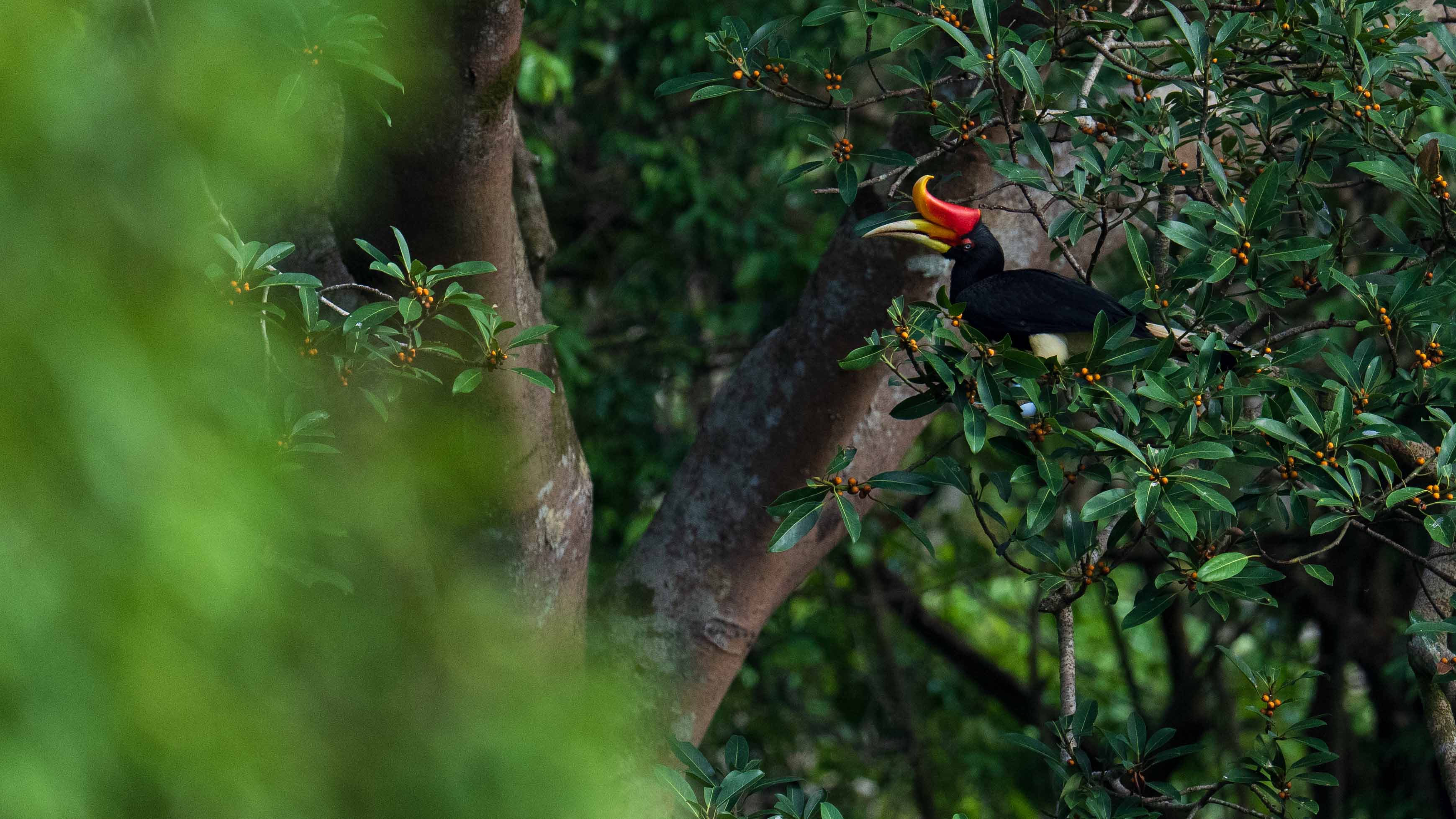
By the end of the day, we visited Chom Sat Viewpoint for hornbills. Unfortunately, only the Rhinoceros Hornbill was visible then, plus an actively singing Grey-headed Babbler. At dusk, a Rufescent Prinia was actively singing. Despite being common, it was also a species I had longed for years.


Day 2: Waiting for the Hornbills
The whole morning on July 1st was about waiting for the hornbills stationarily. It was not rainy anymore. That was a fresh experience for me, since I never tried to do anything like that, unless in a hide with feeders or water pond. Following Sum’s instructions, we climbed a bit uphill from the road headquarters to be well-covered by the vegetation in case we disturbed the hornbills. Here, we saw a large tree with recently matured fruits, which were expected to be attractive for hornbills.

After a long waiting period, a White-crowned Hornbill appeared. It looks, well, slightly less elegant than a hornbill. After hearing it many times in Krung Ching, we finally saw this species. The weather was still heavily cloudy and became foggy every now and then. The White-crowned Hornbill stayed for dozens of minutes before flying away. We also saw a close-up of a Black-throated Oriole and some Green Pigeons and Barbets on the canopy of the Hornbill tree.

We moved between several viewpoints and searched for more hornbills. The following birds were a few individuals of Wreathed Hornbills. It was my lifer yesterday, and I used to long for it for years, but on that day, I really wanted something different. We carefully checked the pouch of every one of them, but all had the black line—that is the key difference to tell the Wreathed Hornbill from the Plain-pouched Hornbill, which is rarer. We had a glance at a Bushy-crested Hornbill coming for the fruits, and it soon fell downhill and became invisible.


The Rhinoceros Hornbills were fairly common, and we heard them multiple times. When we arrived at Chom Sat viewpoint again, the Rhinoceros Hornbills were still there as the previous afternoon. We were then kind of used to the breathtaking scenery from that viewpoint. Following the song, we also found three Black-and-Yellow Broadbills near there. One of them looked like a juvenile.

There were a couple of them. Gibbon was always calling in the background, and we finally saw a flock of them far away. I then better understood the sounds of Gibbons described in the ancient poets. At that time, when the Gibbons were widespread over Asia, it used to be one of the most ordinary sounds, but nowadays, sadly, all Gibbons are threatened and have disappeared in many past regions.
Day 2: Toh Moh Forest Trail

Pratheep suggested we visit another trail in the west for something different. Our destination was Toh Moh Forest Trail, a trail along a stream. We met the Green Broadbill again at the beginning of the trail and were lucky to find a Brush Cuckoo there. Stepping forward, the vegetation became denser, and the humidity grew. I then fell back to the core tropical rainforest and soon became sweaty.

Through the binoculars, I found a “flycatcher”. When perching, the bird showed a bill with a hook at the end and large eyes, together with short feet and a rather erect position, and that made it resemble a typical Old-World Flycatcher. However, Pratheep corrected me that this bird should be a bulbul (Hairy-backed Bulbul Tricholestes criniger) and showed me the entitlement in the Merlin Bird ID app. I scrolled through the figures and was shocked at how it looked like a flycatcher. I probably would never forget his flycatcher-like bulbul. Soon after, Sike found a Purple-naped Spiderhunter. That’s another bird I missed in Yunnan four years ago. The other birds included many bulbuls (most of which were unidentified) and a couple of Lesser Cuckooshrikes near their nest.

We did get a flycatcher. As everything went silent, we heard a thin melodic rhythm from the riparian bushes. When I was browsing any potential Cyornis flycatchers, Pratheep informed me it was a Ficedula. He told us this bird prefers dark bushes along the riverside. We saw the beautiful male birds twice in the very dense and dark bushes. It was a Rufous-chested Flycatcher.

We could hear the call of Rufous-napped Forktail, but it was always too timid to be properly viewed in every encounter. We managed to spot the Rufous-napped Forktail a few more times on the way back. However, it was always quickly escaping from us, which still surprised me. Other forktail species, in my impression, are generally tame and fairly used to humans.

When we stepped near the entrance, Xiaole told us he spotted the Cuckooshrike again from a bush, but it turned out to be a Scarlet-breast Flowerpecker, the last and most difficult species in the region! We were all excited. This trail was certainly brilliant!

Day 2: Afternoon to the night
During lunchtime, we returned to the “sacred tree” and started waiting for the fruit-eating birds to come. The flowerpeckers, barbets, and bulbuls species were almost identical to yesterday, though not as active. The Rufous-bellied Eagle appeared roughly the same time. Compared to the rainy weather on June 30th, the sunny heat wave on that day was a bit worse for us and the birds.


We didn’t leave the site until half past fifteen. When we were about to depart, I just sat into the truck and saw a small, slender, pale bird flaw to a branch. It had a black cap with a scaly-like pattern on the breast, with a rather long tail. I oversaw it carefully, and it took me a while to think about what it was. At that time, Pratheep came to me and informed me it was a Spotted Fantail! It was one of the difficult targets of the trip. Unfortunately, our talk flushed the fantail immediately.
The rest of the afternoon was again waiting for the hornbills in a few open viewpoints. We didn’t see any hornbills. The last highlight of the day was a Black-throated Babbler, which only showed up briefly. It looked more like a typical Stachyris babbler in my knowledge, compared to the Gray-headed Babbler from yesterday. A Crested Serpent-Eagle flaw over us and declared the end of the daytime.

In the evening, we had a night-watching along a river in Sukhirin. Without rubber boots, it became a bit difficult to go across the steam. We were grateful that Pratheep and others helped us pass the river. We saw some frogs and reptiles. The most exciting found was a Wagler’s Pit Viper. Thanks to the Herp Guide Mr. Muhammatpitri Muso, we managed to have a nice view of the viper safely.

Day 3: Along the road
On the third day, we continued exploring the Bala sector but without Sum’s guide. We spent most of our time birding along the road. Contrasting to staying rather stationary as the past two days, Pratheep commented, we finally moved from a more “bird photography” style back to “bird watching.”
The morning of the third day started from Chom Sat Viewpoint. Xiaole spotted a Binturong and became extremely excited. What I saw was barely a squirrel with a cat-like beard. The Rhinoceros Hornbill was still there, never letting us down. For the other hornbills, we only briefly spotted a White-crowned Hornbill that Pratheep planned to show us, but we were too slow to see it properly. We heard two species of gibbons, but neither were visible today.


Hiking along the road, we often saw a flock of bulbuls or flowerpeckers feeding on the canopy high up in the trees. Some birds were too far to identify, and they were always moving. Those difficult birding styles recalled my old days of birding in Yunnan. I heard the snores of the Red-bearded Bee-eater, which could be seen as a small dot at the canopy, and the anxious calls of several woodpeckers, though none showed up for long.
When we occasionally stopped on the road, I glimpsed at the roadside and saw a red bird jump from the jungle to a horizontal vine. I said unconsciously and showed others this bird immediately. This was a male Scarlet-rumped Trogon. That was my first time to be such close to a Trogon, and I felt that the air was almost frozen. We kept silent and spent about a quarter with this bird. That was such an unforgettable experience. On the way back, we spotted another two males on the way.


In the late morning, there are some commonly heard melodic rhythms. To begin with, I thought it was from some very nice Niltava or some at least, “rare birds” for birdwatchers. However, my experience in Fujian made me aware that this form of song was closer to Alcippe Fulvetta. I was deceived by Huet’s Fulvetta (Alcippe hueti) song for other less common species (“better” birds for birders) many times when I was in Emeifeng. After checking the Merlin App, I confirmed that the song was from Brown Fulvetta. I saw a few flocks afterward as well and confirmed the song by watching it singing.

Malkohas are relative to cuckoos, but they are not brood parasites. Those long-tailed perching birds are usually exclusive and well-hidden in the canopy, making them a bit difficult to see. Before I arrived in Thailand, the only species of Malkoha I had ever seen was the common species, Green-billed Malkoha, which is basically everywhere in its region. In Hala-Bala, we met the Raffle’s Malkoha, with a sexual dimorphism and fairly tiny size. Another species, Black-bellied Malkoha, was larger and almost a “darker Green-billed Malkoha”. I still knew little about their ecology, but they at least are elegant and beautiful birds to watch.

Day 3: The last session
At about noon, we could hear a song by Banded Broadbill. We heard it all the time from the first day but never saw one. We did have the chance to see one in Krung Ching, but it was too brief that I even had no chance to focus properly with the camera. This time, Pratheep finally helped us get one perching silently. When using playback, they would come but barely make any noise. We started to appreciate this funny-looking bird. Although the color scheme reminds me of Black-and-yellow Broadbill, it was indeed much larger! It feels like the size of a Roller.

We had lunch at one of the lower shelters. Here, we finally got the chance to see the Silver-rumped Spinetails properly. The spinetails showed two “spines” by the end of the tail when the rectrices folded, and they seemed to be another different group of swifts compared to the “needletails,” which were more familiar to us. There was always something not so nice, like that we even found a leech in the lunchbox.


At the hottest time of the day, Pratheep guided us to the resort area of the Bala sector. While he felt slightly unwell, he slept a bit in the van, and we explored the resort. There was a botanical garden, and many spiderhunters, including Gray-breasted and Long-billed Spiderhunter, were foraging in the flowers of Zingiberaceae. Here both the Germain’s Swifts and Silver-rumped Spinetails were fairly common. During the day, we didn’t see any other hornbill, except for several Wreathed Hornbill.
We kept seeing Whiskered Treeswifts everywhere, but that day, we got a good chance to have a close-up well of a cute female bird perching on a dead branch across from a construction site. Their behavior reminds me of Muscicapa flycatchers: they usually stationarily perch on the tip of the dead branch, sometimes fly over, make a circle track, and return to the same place.

By the end of the day, we stayed at Chom Sat Viewpoint again. The sky had been cloudy and then foggy, there seemed to be no hope of Helmeted Hornbill or Wrinkled Hornbill, but we found the Rhinoceros Hornbill was super close. As we moved to better look and take photos, it even flaw to a closer tree several times. There were no Ficus fruits on those trees. We then decided to spend our last hour in Hala-Bala with this Rhinoceros Hornbill. When we started to leave, surprisingly, the hornbill also left and went back to the forest—it was just curious and was observing us as well! What an experience. Hala-Bala was such an amazing place that I would love to revisit here in twenty years.

Other animals from Hala-bala, from left to right, up to down:
Indaeschna grubaueri, Pyrops pyrorhynchus, Gekko hulk, Draco sumatranus, Draco sumatranus, Hylobates agilis


eBird Trip Report: https://ebird.org/tripreport/257527
Leave a Reply