
29/12/2021 Madrid: Open fields near Daganzo de Arriba
Because one of my friends got a stomach ache, we didn’t go birding the whole morning. We had a quick lunch near the hotel and visited the open fields east of the city during the afternoon. We spent most of the time in Daganzo de Arriba.


It was the last day for birding, so we decided to take it easy and just drove to the places that looked like open fields on the map. We visited a rather general area and looked at all the birds around. We were aimed for Little Bustard and Stone Curlew and a collection of birds in an open area. The habitats were mainly agricultural regions and some small woods and bushes. It seemed it rained since the paths and roads had some pits.
Agricultural fields are always crucial for wintering birds, especially places with a long farming history, where birds have already adapted to agriculture. On the fields, we saw some flocks of Northern Lapwings, Spotless Starlings, and Eurasian Linnets. There were also some larks, though I could only confidently identify Eurasian Skylarks and Crested Larks. We had an Iberian Woodpecker and an Iberian Gray Shrike at the field’s boundary. Among the bushes at the edge of the fields, we got a flock of European Goldfinch, several Eurasian Magpies, a pair of European Stonechat, and a few Corn Bunting. In the sky, wintering Red Kites were very common. Other birds of prey included the Eurasian Marsh Harrier, Common Buzzard, and Cinereous Vulture; all were not rare as well. Nothing was unique, but seeing so many birds having a comfortable life in the farmlands was pleasant.


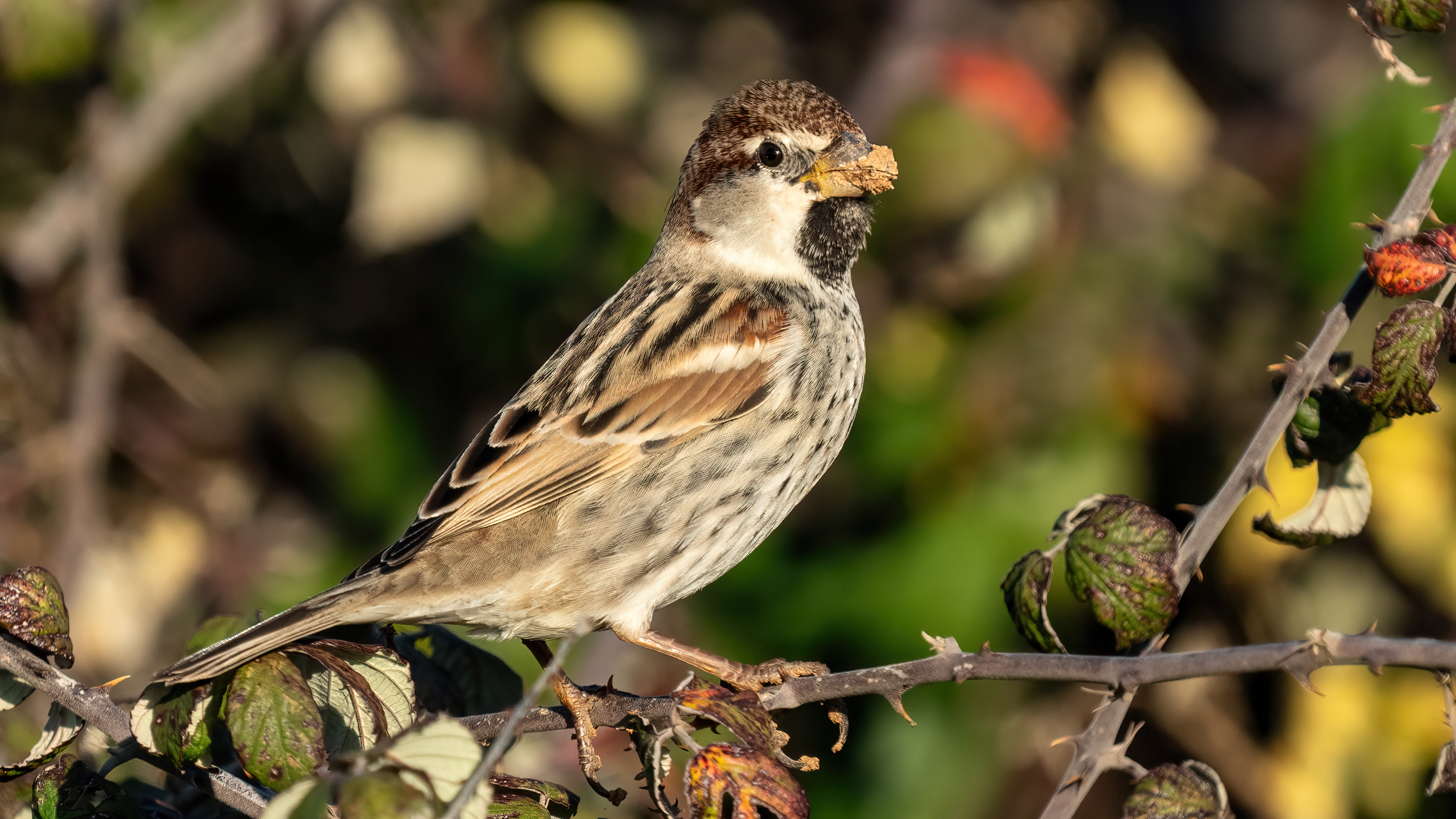
There were also two small highlights for me. When checking a small group of House Sparrows, I found a male Spanish Sparrow. According to the name, it would be a must-see in Spain. Seriously, I had been longing for this bird for a long. A few years ago, I started searching for the birds in Northern Xinjiang, but they were too rare to be spotted by me then. That was the first time I saw one in the field. Even in winter, it was so remarkable with a pretty striped underpart. The female, however, is almost indistinguishable from the female House Sparrow. It would also be interesting to look into its evolution and speciation with House Sparrow.


In a small wood, we spotted a flock of 10 Long-tailed Tits. These birds, however, still belong to the europaeus subspecies group, rather than irbii in south Spain. I had only seen caudatus, the whitest subspecies in China and Sweden, so I got interested. Some people may find it hard to be distinguished from another species, the Silver-throated Tit (Aegithalos glaucogularis), but in fact, the pink color in the upperparts and flanks are pretty distinguishable from glaucogularis. They were always active birds, nearly restless, and sometimes, I would wonder about the functions of their long tails.


On the last day of the trip, we suddenly had the most dramatic experience. Our car was stuck on a muddy path in the center of the field. There were only a few minutes to sunset, and there seemed to be nobody around within a few kilometers. I tried to put some dead branches under the tire, yet the road was too muddy. It had already become a pit, and the branches did not work. It started getting dark and cold, and we felt hopeless.

We couldn’t push or pull the car. We called 112 and got the reply that they would send people in 20 minutes. When I decided to give up and wait for rescue, my friend Zhengyi was still trying to move the car. Suddenly, he came up with some idea and got into the car. The path was lifted from the field, so it was higher than both sides. There was nothing in the field at that time in winter. He soon managed to drive the front part of the car to one side, and the car fell into the field due to gravity. Then the car was still within his control, and he drove the car for a distance and suddenly went back to the path again, in the safe and plat part. I was shocked by this brave behavior. Anyway, both the car and us were safe now. We made it! It was already 1 hour after we called the 112, and they had not sent any rescue people yet. We told them to cancel the rescue.

We returned the car and headed back to the city. On the road, we saw several Eurasian Marsh Harriers who landed in one grassland region and stood at an equal distance from each other. We were unsure of the reason and sadly had no time to follow up. After that, we would use public transportation. Since the car rental service was far from any subway station, we asked for a shuttle to the airport, where we could quickly get the subway to the hotel. When we were about to board, the driver kindly reminded us to take off our boots. We then just realized we already had filthy and muddy boots. I was still frightened by this car-stuck experience until I reached our hotel.
Leave a Reply