
In early July 2021, we heard about the new Orange-breasted Green-Pigeon (Treron bicinctus) in Hainan. Despite the fact we just went on a birding trip to Hainan (Epic 101-Hour Journey: A Birding Adventure from Shenzhen to Danzhou), we decided to make a weekend blitz again for this single Pigeon, as well as other potential lifers of us. Jun was interested in some owls there as well.
Table of contents
Orange-breasted Green-Pigeon
We arrived at Haikou on Friday evening and drove to Gaoshanlang Village the next morning. We departed extremely early. We started to encounter some specialties of Hainan, including the residential Shikras.


We arrive at Gaoshanlang Village at around 7:30 AM. Outside the village, there was a wood patch that was supposed to be the habitat of the Green Pigeon.


We heard the sound of the Green-Pigeon, and soon, Jun found a male there. Tianyang and Shaoping also saw it, and I was the last one. It was not small but very well hidden in the tree with its camouflage. The orange and pink breast parts of the male were not that significant in the distance. There were four individuals in total.


It always went more smoothly than we thought. As we walked around the village, we heard some very noisy, chicken-like sounds. Then, a female Red Junglefowl () jumped out, and all other noise disappeared. Jun inferred that there was a group of males displaying for this female just now.

We then drove to Danzhou for the owls in the evening. Slaty-backed Rail was one of the most wanted birds for me in Hainan. On the way, we accidentally found two feeding on snails just next to the road. We parked briefly for the rail. It was my lifer.


Back to Danzhou
When crossing Danzhou Bay, we tried to find a Germain’s Swiftlet (Aerodramus germani) again. We used a speaker, but maybe the volume was not high enough; what we got were still only House Swifts (Apus nipalensis ), the most common swift in Hainan.


During the afternoon, we stayed in a mixed open area of Danzhou, near the village called “Huangyu (黄玉)”. That was one of the same places we visited in May. It didn’t change much in two months, except that most waders in May had already left. Black Drongo (Dicrurus macrocercus), White-shouldered Starling (Sturnia sinensis), and Red Collared-Dove (Streptopelia tranquebarica) were still the three most common birds perching on trees. A few Blue-tailed Bee-eaters (Merops philippinus) were feeding around the wires. They arrived probably after our last visit.


Around 7 PM, it was about to get dark, so we decided to leave for dinner. Jun was driving when I saw something from the side window. Francolin! I had never seen such an exposed one, just standing at the edge of the grassland. We were intrigued and took the rest of the dusk observing this male Francolin running hundreds of meters and diving into some bushes. Such a sweet experience!


Nightwatch: The Owls
After it got dark, the night watch started. We explored the woods in Pokanling with a local guide. A lot of rats could be seen on the way. With such a rich food resource, we expected a variety of owls in the woods.

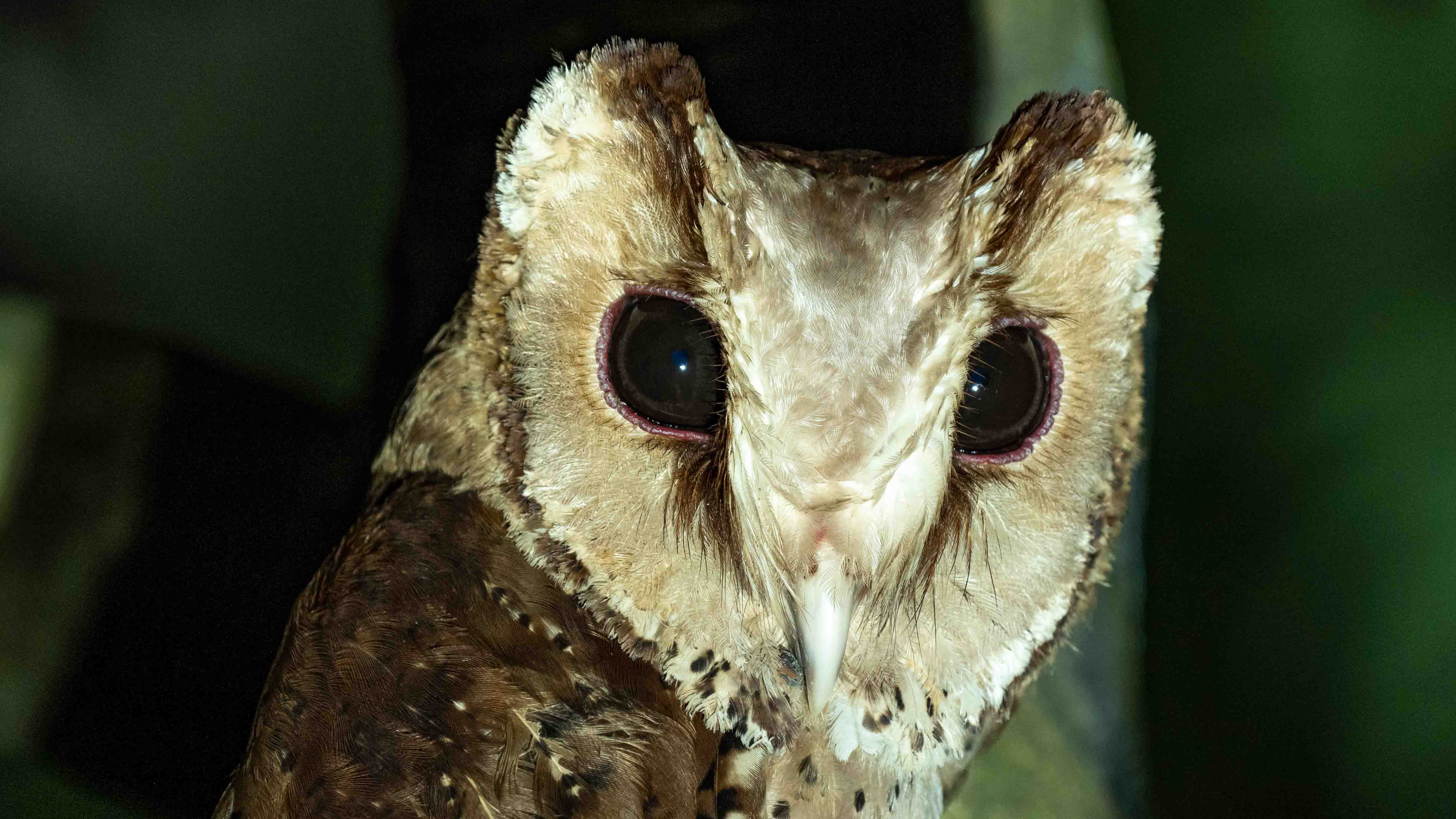
Collared Scops-Owls (Otus lettia) were the most common birds. We saw about four individuals. Jun and Tianyang’s main target on this trip was the Oriental Bay Owl (Phodilus badius). We made some effort to search for this bird. Once this species was found, it would become very tame and easy to approach and take photos of. Nevertheless, we did not want to disturb it too much.


Before midnight, we heard the Brown Wood-Owl (Strix leptogrammica). To be honest, I was not aware of its existence in Hainan before that day. It showed a bit of response to the playback, and we finally located this large exclusive owl on a dense branch. So far, we achieved all the targets.

Sunday: Watercock
Jun and Tianyang wanted a lazy morning, while I still wanted to go to the Watercock (Gallicrex cinerea). The Mandarin name “董鸡” was derived from its impressive “dong” call. Thus, I drove to the Huangyu again, and Shaoping kindly joined me. That was actually my first time driving in a village area of Hainan.

We arrived shortly. Despite the early hours, it was already fairly hot, and birds started to become inactive, except for about 50 Blue-tailed Bee-eaters, and another 70 Oriental Pratincole (Glareola maldivarum), both actively catching insects in flight. Shaoping claimed she saw a Wood Sandpiper (Tringa glareola) with chicks.
We waited in the car for the Watercock to show up from the fields. During one hour, Yellow Bittern (Ixobrychus sinensis), Cinnamon Bittern (Ixobrychus cinnamomeus), and White-breasted Waterhen (Amaurornis phoenicurus) took flight from the rice fields one by one. We finally spot a female Waterhen flying across the road and over the rice. It looked like, uhh, a juvenile White-breasted Waterhen, just with a darker face.

We still wanted to see the male Waterhen. Meanwhile, I was attracted by a Scaly-breasted Munia (Lonchura punctulata). In Hainan, this is one of the most common birds in agricultural fields, feeding on seeds of crops or grass. I had seen this species and such a scene countless times since I started birding. However, a mysterious force drove me to put my camera on this bird and take photos and videos. It was so charming that I could barely move or even breathe.

Suddenly, Shaoping informed me the male Watercock had appeared. However, I was still focusing on the Munia for so long that I couldn’t turn my gears immediately. When I finally saw the Watercock male and was ready to take a photo, that was what I got:

As we decided to drive back, a few Ashy Woodswallows stood on the wires, together with Blue-tailed Bee-eaters, a Whie-breasted Kingfisher, and a Black-shouldered Kite. Shaoping is apparently interested in the woodswallows. They usually occur in tropical forests, while here, they are just in agricultural areas of Hainan.

A few other photos here. We left Hainan on Sunday night.


eBird Trip report: https://ebird.org/tripreport/184084
Leave a Reply