
In early May 2021, with a few friends, I took a twitching trip for the Silver Oriole, Savanna Nightjar, and Chinese Grassbird to Guangdong during the Labour Day break. It was my last long-distance twitching trip with a few particular targets and an unforgettable adventure.
Shenzhen 深圳
I arrived in Shenzhen on April 29th, 2021, with Shaoping. It was one day before the trip, but I don’t remember why I went there early. After the flight landed, we went to the city parks for a warm-up birding. Our first stop is Shenzhen Ren Cai Gong Yuan (人才公园), a city park near the southwest coast. Shaoping intended to find a White-shouldered Starling (Sturnia sinensis) here, which had been recently recorded. There were some common residents here in the park. On the rocky beach of the park, many migrant waders were also perching; most were Pacific Golden Plovers (Pluvialis fulva) mixed with some Tibetan Sand-Plovers (Anarhynchus atrifrons), Terek Sandpipers (Xenus cinereus), and Curlew Sandpipers (Calidris ferruginea). I had not been aimlessly birdwatching like this for so long that I found this park relaxing and enjoyable. After a tedious trek with luggage, we had no luck finding the White-shouldered Starling.


We spent two hours in Ren Cai Gong Yuan and then moved to Futian Mangrove Ecological Park (福田红树林生态公园), another nearby city park. We met our old friend Canzhong, who worked in park management there. The canopy density in this forest area is slightly higher, and there are also slightly more forest birds. I tried to explore the birds in the mangroves, but here, I only got the most common birds in the park: Common Sandpiper (Actitis hypoleucos), Black-crowned Night Heron (Nycticorax nycticorax), and Crested Myna (Acridotheres cristatellus).


We stayed in the hide at the Mangrove Park. There were a few mudskippers, with several predators, including Common Greenshank (Tringa nebularia), Common Redshank (Tringa totanus), White-breasted Waterhen (Amaurornis phoenicurus), Chinese Pond-Heron (Ardeola bacchus), and Common Sandpipers. A Greater Coucal (Centropus sinensis) was strutting along the shore, and a Plain Prinia (Prinia inornata) sang incessantly on the grass like a wind-up toy. The mangrove forest was imbued with an added touch of tranquility.


At dinner time, we scouted the site for the Savanna Nightjar (Caprimulgus affinis). Savanna Nightjar is a common bird in Shenzhen, and it even inhabits open areas in the city, perching at the tall buildings during the day and feeding in the sky at night. In the Mandarin name, it was called “林夜鹰,” which means “forest nightjar.” This name is confusing, as the bird has nothing to do with “forest.” It seemed like a dark shadow flew by, and upon closer inspection, it turned out to be a Black-crowned Night Heron. After spotting two Night Herons, the next bird in flight was the Savanna Nightjar. It had a distinctive, clear, single-strophed “ju-ah” call, with a gap of about three seconds between every two notes. This call differs from other nightjar species with high-frequency, continuous, machine gun-like calls.


After dinner, we went to the airport, gathered with Jun and Tianyang, and picked up the rental car. We waited until another friend’s delayed flight arrived and then headed to Conghua. The warming up had ended, and the main course would soon begin.
Conghua 从化
We arrived at Xitou Village (溪头村) in Conghua after midnight. It is a village near Jizhen Mountain (鸡枕山), where the Silver Oriole (Oriolus mellianus) usually occurs in summer.
May 1st, 6:00 AM, our formal birding trip started. When we departed, a Black-capped Kingfisher (Halcyon pileata) flew over us into the mountains. The “come to the peak ha-ha” call of Chinese Francolin (Francolinus pintadeanus) was everywhere, but we hardly saw one. The local transcribe of this sound is “行不得也哥哥,” which means, “You can’t do that, old brother!” What was easy to see here was the Greater-Necklaced Laughingthrushes (Pterorhinus pectoralis) among the bushes. On the way uphill, we heard many Asian Koels, a Larger Hawk-Cuckoo (Hierococcyx sparverioides), and one Square-tailed Drongo-Cuckoo (Surniculus lugubris).

The Silver Oriole occurred near the reservoir at the top of the Jizhen mountain, and the last part of the road was inaccessible to cars. We thus found a place to park and walked to the reservoir. When we arrived, we started to wait for the Silver Oriole, as it was said that the bird would show up after waiting for a while.
Some birds were flying over the reservoir, most were minivets, and others were Hair-crested Drongos (Dicrurus hottentottus). I took photos of every bird that passed by and was larger than a minivet. A Crested Goshawk soon appeared with a frog caught in the claws. Suddenly,

Finally, both the Crested Goshawk and the drongos disappeared into the subtropical forest. We didn’t know who the final winner was. Meanwhile, I found a Silver Oriole in flight! I thought it was a drongo at first, but then the whitish belly and white iris indicated its identity. I then took a quick photo. Unfortunately, I was the only one who managed to see this bird. The rest of us still needed to see the bird properly.

After another long wait, we finally had another Silver Oriole appear! It perched on a lower branch in the valley for a few minutes. Readers may wonder if the Silver Oriole is only a differently colored Maroon Oriole (Oriolus traillii). For the male, it looks like Silver Oriole replaced all the parts in red of Maroon with white. One difference worth noting is that the Maroon Oriole is always resident, while the Silver Oriole is a long-distance migrant like many other old-world Oriole species. It is said that, in some years, they would only pass the Jizhen Mountains without staying for breeding.

As everybody was pleased now, we left Jizhen Mountain and headed back to Shenzhen to have another look at the Savanna Nightjar for the three of us who missed it yesterday.
On that day, the Savanna Nightjar started activity slightly later than the day before. We saw three nightjars fly and sing, and we heard more individuals. In flight, their shape resembles that of a raptor, which may be the source of the Mandarin name. We found the same individual I took photos of yesterday on the same handrail and managed to take a few more pictures with a flashlight shortly.


After a quick dinner, we rushed to Yangxi overnight and went to a hotel near Longgao Mountain. The trip for the first two targets, Silver Oriole and Savanna Nightjar has gone smoothly so far. We were ready to search for the mysterious Chinese Grassbird for the rest of the holiday!
Yangxi 阳西
It was said that spotting the Chinese Grassbird (Graminicola striatus) could be extremely difficult, so we planned to take the rest of the holiday for this single species. We arrived at Longgao Mountain (龙高山) on May 2nd, 7:40 AM, and drove up the mountain. The place was described in the literature about the distribution of this species[1].
We meticulously searched every tall grass patch, becoming overly cautious when we saw any moving branches. Although we assumed one could become a Chinese Grassbird, it always became a Red-whiskered Bulbul (Pycnonotus jocosus), which was frustrating. Meanwhile, we heard a few Chinese Francolins, Larger Hawk-Cuckoos, and a very far Chestnut-winged Cuckoo (Clamator coromandus).

The mountain road was short, and we reached the top after one hour’s drive. Under the massive wind turbines lay a meadow with grass barely reaching knee height, interspersed with a few shrubs. The grass was too low for my expectation for the habitat of the Chinese Grassbird. However, Jun declared he heard one shortly after we left the car. Following the call, we managed to locate a couple of Chinese Grassbirds. They were carrying the leaves for nest building. The supposedly rare Chinese Grassbird appeared right away.


There had been a change in the Mandarin name of Chinese Grassbird. It used to be called a “warbler” and now a “babbler”; I prefer the new name. According to the ecological niche model by Zheng et al., 2021, the potential habitat elevation for the Chinese Grassbird is predicted to increase. Perhaps the current urban expansion is forcing them up into the mountains. Before the intensive human colonization and exploitation in Southern China’s coastal areas, was the Chinese Grassbird as common as the Plain Prinia? I hope they can sustain in this land for a while longer.

On the way back to the city, we were attracted by an ethereal and melodious song. We made a stop and tried to find the source. After much effort, we finally spotted a young male Hainan Blue Flycatcher (Cyornis hainanus) perching behind very dense branches and vines. Its plumage looked dull, but the song was beautiful. Soon, we heard a two-syllable “beep-beep” sound approaching us. We realized it was a Hodgson’s Hawk-Cuckoo (Hierococcyx nisicolor). When we were about to leave, it suddenly flew from behind us. Jun asked me whether I would count this Cuckoo as a lifer. I answered yes since I had a proper view of the bird in flight and heard it clearly to identify it. We guessed that the Cuckoo was maliciously tracking the flycatcher for a potential host of brood parasites.

We had seafood for lunch in Yangxi to celebrate. Since we had finished all the main targets of the trip, we went to a nearby birding site called Santouzui (散头咀) for waders. We found several breeding White-faced Plovers (Anarhynchus dealbatus) there. Both Siberian Sand-Plover (Anarhynchus mongolus) and Tibetan Sand-Plover were also on the site, and there were also many other waders. However, the garbage washed up by the waves made the beach somewhat distressing.

Haikou 海口
The story was supposed to end there, but we only spent one day and a half of this five-day break, and the rental car should be returned on May 5th. Jun suggested we go to Shiwandashan (十万大山) in Guangxi for Gray Laughingthrush (Garrulax maesi), while I mentioned that Hainan might be a better idea for birding, as all of us have more potential lifers there. We finally decided to explore Hainan, stop at Haikou, and then go to Danzhou for grassland birds.
However, Hainan was still far from us. After saying farewell to one team member, Hua, in Yangxi, we drove to Zhanjiang and boarded a ferry to cross the Qiongzhou Strait. It was already dark. I hadn’t expected my first experience in this famous strait to be in total darkness, accompanied by the cabin’s heat and the engine’s roar. We arrived in Haikou at 10 p.m. The roads were not busy, and we heard two Savanna Nightjars on the way to the hotel.
On the morning of May 3rd, we followed a local friend’s suggestion to visit Wuyuan River Park (五源河森林公园) looking for the bee-eaters. We first made a stop at a gas station. I thought it would be much easier to spot the White-shouldered Starling in Hainan compared to Shenzhen. Still, all the starlings we found had been replaced by Red-billed Starlings (Spodiopsar sericeus). Besides the individuals I saw migrating through Rudong (如东) before, I hadn’t seen the White-shouldered Starling again. How different and divergent are the migratory and non-migratory populations of this species?
Finally, Shaoping excitedly shouted that she had seen a confirmed White-shouldered Starling! Unfortunately, the bird disappeared instantly, and the only birds friendly to us were two Eurasian Hoopoes (Upupa epops) near the parking lot.

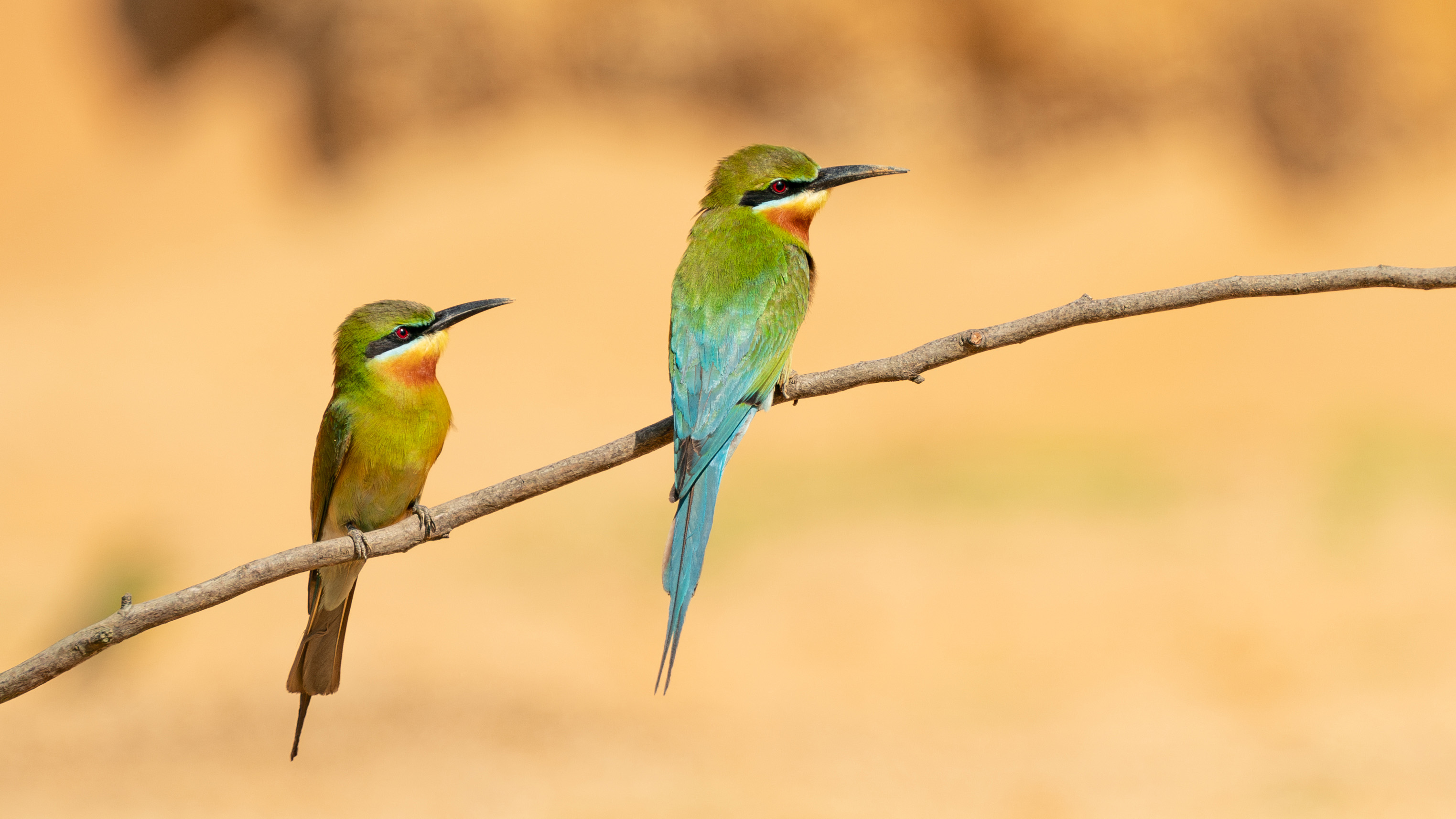
The sand and stone piles formed from sand or gravel excavation in Wuyuan River were preserved during the ecological restoration of the wetland, making them ideal nesting sites for bee-eaters. The Blue-tailed Bee-eater (Merops philippinus)was the primary resident here, a bird beloved by the citizens of Haikou and considered the city’s symbol. The cliffside is densely packed with burrows dug by the bee-eaters. According to the park’s information boards, the bare cliffside might be a strategy for bee-eaters to protect their nests from predators. I read this with skepticism.


Next to the nesting site was a specially built hide for tourists to observe and photograph the bee-eaters, where we took many pictures of the birds. The Blue-tailed Bee-eater’s hunting prowess is impressive; even fast-flying dragonflies fall prey to them. Sometimes, the bee-eater doesn’t eat its prey immediately but rather perches on a branch, repeatedly swinging the prey. Jun suggested this might be part of a courtship display.


Compared to the abundant Blue-tailed Bee-eater, I had been longing for the Blue-throated Bee-eater (Merops viridis) much more. I missed them in Dongzhai in 2018 and had never seen them before. Luckily, we found a couple in Wuyuan River mixed with Blue-tailed Bee-eaters and another couple by the roadside when we drove to the next destination.

Danzhou 儋州
Danzhou (儋州) was the next stop. We passed Guangcun Silver Beach (光村银滩) on the way. There used to be many Crested Tern wintering. But in May, we saw barely countless herons and egrets leisurely fishing between the mangroves and the beach.

We arrived at Danzhou Bay (儋州湾) in the afternoon. Finally, there were many White-shouldered Starlings and easy to spot. They seemed to prefer the electrical wires compared to other starlings. There were also some Common Mynas (Acridotheres tristis). We saw several flocks of Scaly-breasted Munias (Lonchura punctulata) flying by and the Spotted Doves (Spilopelia chinensis) and Black-winged Kites (Elanus caeruleus) on the electric wires.


With the help of a local forest ranger, Mr. Chen, we got a glimpse of the Grass Owl (Tyto longimembris). Unfortunately, a Black Drongo (Dicrurus macrocercus) suddenly appeared and chased it all the way.


The Grass Owl had landed somewhere when I heard Jun calmly say, “Lesser Coucal.” I got a bit excited, and following his direction, I saw a large black bird with brownish wings perched in a taller patch of grass. Although it looked like the Greater Coucal at first glance, the dark iris of the Lesser Coucal indicated the difference. Besides pipits, there were also some Oriental Skylarks (Alauda gulgula) in the grasslands. They were the subspecies coelivox. Among the cattle, we didn’t see the typical Eastern Cattle Egrets or Common Mynas, but Black Drongos were perching on the cows’ backs.


We got back into the car and continued birding in the wetlands. Suddenly, Shaoping said there was a Greater Painted-Snipe (Rostratula benghalensis). I searched along the water field’s edge with my binoculars for a long time but saw nothing. Shaoping pointed it out and whispered, “Look over there.” It turned out to be hidden in a very dense clump of grass. I spent a long time trying to locate it in the grass, and with Shaoping’s guidance, I finally saw a glimpse of a red nape. We parked the car and waited a few minutes. The Painted-Snipe gradually turned its head, revealing a side. It was a fantastic female, which looked more colorful than the male in this species.

Later, at a nearby small lake, we saw a pair of Lesser Whistling-Ducks (Dendrocygna javanica). After a while, Yellow Bitterns (Ixobrychus sinensis) and Cinnamon Bitterns (I. cinnamomeus) appeared. The most abundant birds in the rice fields were Zitting Cisticolas (Cisticola juncidis), and many were in their song flight.


The fields of Danzhou Bay also hosted a large number of migrating waders. At that time of year, hundreds of Pacific Golden Plovers and various Tringa sandpipers were feeding there. Additionally, the sky was filled with Oriental Pratincoles (Glareola maldivarum). If approaching, they would alarm and hover over a limited region. Some may have their nest nearby. Various herons were also common here, often gathering in large flocks at dusk.


Before dinner, we passed Danzhou Bay Bridge, where many House Swifts (Apus nipalensis) flew and fed in the sky. We tried hard to spot a Germain’s Swiftlet (Aerodramus germani) among the numerous House Swifts but never succeeded.


In the evening, we finally had the chance to observe Blue-breasted Quails (Synoicus chinensis) and a male Barred Buttonquail (Turnix suscitator). The Blue-breasted Quail were in a small flock. When illuminated by the light, they would briefly stop to preen themselves before trying to move away.


Fengtang Village 丰塘村
Before returning home, we had one last target: the White-browed Crake (Poliolimnas cinereus). It was a species that recently dispersed to Hainan. We heard about several spots that year and chose the nearest one, the Fengtang village (丰塘村).
On the morning of May 4th, we arrived at the village’s wetland. There were some wooden boardwalks along the reedbeds. We saw many waders flying around beside Black-winged Stilts (Himantopus himantopus) and Spotted Redshanks (Tringa erythropus); there was a flock of 30 Black-tailed Godwits (Limosa limosa), among which only two were in complete breeding plumage. Red Collared-Doves (Streptopelia tranquebarica) were particularly numerous. We heard a Black-browed Reed Warbler singing from the reed and had a feeling of the upcoming summer.

Several patches of floating vegetation looked suitable for the White-browed Crake. We explored the region for about one hour. After a few false alarms of Eurasian Moorhens (Gallinula chloropus) and White-breasted Waterhens, I finally found a White-browed Crake. When I called the other guys, it disappeared quickly. Later, Shaoping found another one, and it also vanished fast. I couldn’t remember how long it took, but we finally waited for the first bird to appear again and had a nice view. The behavior of the White-browed Crake is not much different from other crakes. However, its Southeast Asian color pattern clearly marks it as a non-native bird. We ended up seeing a total of three White-browed Crakes in Fengtang Village.

Then, it was the long journey back. We passed Danzhou Bay Bridge again and saw numerous House Swifts but no Germain’s Swiftlet. We later learned that most birdwatchers would use playback of their calls to attract the Swiftlets. On the ferry across the Qiongzhou Strait, we could see Little Terns (Sternula albifrons) and Bridled Terns (Onychoprion anaethetus) in the distance. We bought a pineapple in Xuwen in Zhanjiang and continued our drive back to Shenzhen. Tianyang did almost all the driving on this trip, and we were all very impressed and grateful.


This trip started at noon on April 30th in Shenzhen, and the last birding record was at 5 PM on May 4th on the boat at the Qiongzhou Strait. We spent 101 hours and had 132 bird species, including 21 lifers for me. It was the most intensive birding experience of my life and likely to be the last of its kind. Since then, my interest in sheer bird species numbers has gradually shifted towards bird ecology, behavior, evolutionary history, and related social cultures.

Frogs, crabs and butterflies

Food at the Cantonese Yale in Shenzhen
Reference:
- Zheng, X., Lewthwaite, R., Martinez, J., Yu, Y. T., Liu, Y., Yang, L., & Chan, B. P. L. (2021). Distribution and status updates of Chinese Grass-babbler Graminicola striatus in China: Implications for its global conservation status. Global Ecology and Conservation, 26, e01463.
eBird Trip Report: https://ebird.org/tripreport/217226
中文版本链接:https://mp.weixin.qq.com/s/6ACLvo8yoWLb-y9X3QkhKg
Explore more about birds of East Asia:
Explore more about birds of Europe:
IJmuiden🇳🇱
Madrid🇪🇸
Leave a Reply